NISM Series-V-D SIF Distributors Certification: Complete Exam Guide 2026
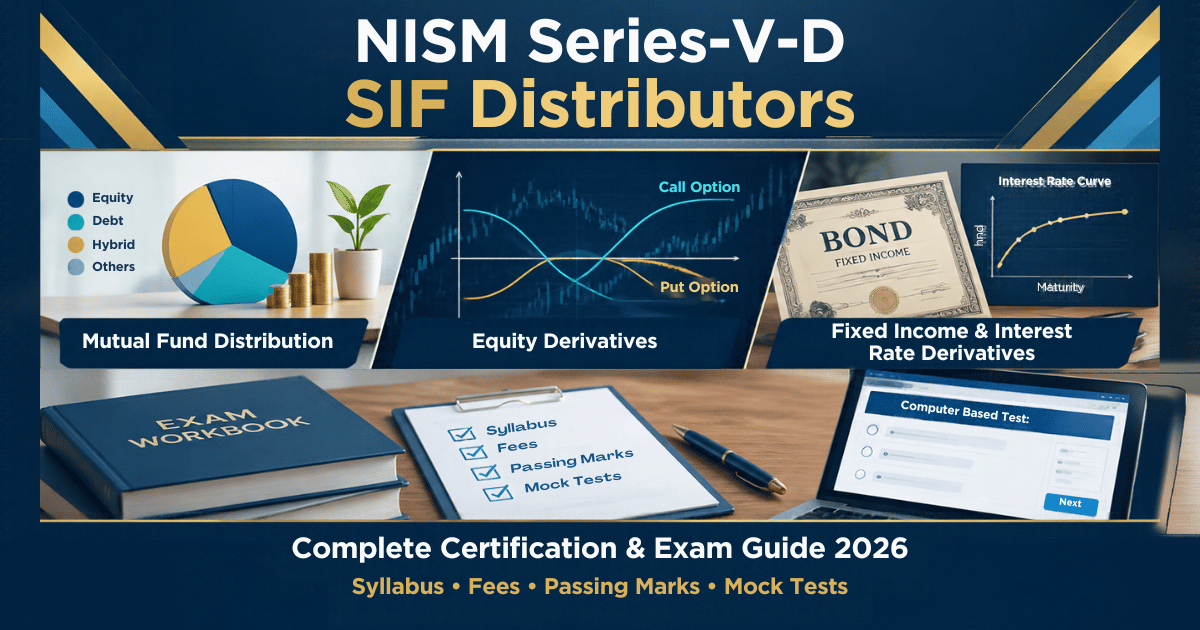
The NISM Series-V-D SIF Distributors Certification Examination is designed for professionals involved in selling and distributing mutual funds and Specialized Investment Funds in India. It combines mutual fund distribution knowledge with equity derivatives, fixed-income securities and interest rate derivatives, making it broader than the conventional mutual fund distributor examination.
The examination became available on 22 July 2026. A valid Series V-D certification enables an eligible person to distribute both mutual fund and SIF products without separately holding the NISM Series V-A Mutual Fund Distributors Certification, subject to the applicable regulatory, registration and operational requirements.
If you have started preparing, attempt the Free NISM Series V-D SIF Distributors Mock Test to assess your understanding before moving to full-length practice tests.
What Is the NISM Series-V-D SIF Distributors Certification?
The full name of the examination is the NISM-Series-V-D: Mutual Fund – Specialized Investment Fund Distributors Certification Examination. It is conducted by the National Institute of Securities Markets, or NISM, to establish a common minimum knowledge benchmark for people engaged in the sale and distribution of mutual funds and Specialized Investment Funds.
The certification is relevant to individual mutual fund and SIF distributors, employees of distribution organisations, AMC sales personnel, wealth managers, relationship managers, brokers, agents, authorised persons and other professionals who sell or support the distribution of these investment products.
For detailed information about the certification route, syllabus and distribution opportunity, read the NISM Series V-D syllabus and SIF distributor guide.
What Is a Specialized Investment Fund?
A Specialized Investment Fund, commonly called an SIF, is an investment product operating within India’s mutual fund regulatory framework. It was introduced to address the space between conventional mutual funds and Portfolio Management Services by permitting greater investment-strategy flexibility under the applicable SEBI framework.
SIF strategies may use equity, debt and derivatives within the applicable regulatory limits. Because these strategies can be more complex than conventional mutual fund schemes, distributors need a working understanding of investor suitability, risk profiling, portfolio construction, futures, options, fixed-income instruments and interest rate derivatives.
You can also watch the SIF Distributor Certification 2026 session covering the NISM Series V-D exam and SEBI rules for an additional overview.
Who Should Take the NISM Series V-D Examination?
The examination is suitable for professionals who are engaged, or plan to become engaged, in the sale or distribution of SIF products. Relevant candidates include:
- Mutual fund distributors who want to add SIF products to their offering
- ARN holders serving experienced or high-net-worth investors
- Employees of banks and Non-Banking Financial Companies involved in investment distribution
- Relationship managers and wealth-management professionals
- Employees of Asset Management Companies involved in sales and distribution
- Brokers, agents and authorised persons involved in SIF distribution
- Financial-services professionals planning a career in mutual fund and SIF distribution
Passing the examination should not be treated as completion of every legal or operational requirement. Depending on the candidate’s role and business model, AMFI registration, ARN or EUIN requirements, AMC empanelment and other applicable compliance conditions may also need to be completed.
Is NISM Series V-D Mandatory for SIF Distributors?
A valid NISM Series-V-D: Mutual Fund – Specialized Investment Fund Distributors Certification is the prescribed certification for persons engaged in selling or distributing SIF products. A valid Series V-D holder can distribute both mutual funds and SIFs from a certification perspective without separately holding Series V-A.
Professionals engaged only in conventional mutual fund distribution may continue to comply with the NISM Series V-A certification requirement. Candidates who are unsure which examination applies to them should read the detailed difference between NISM Series V-A and V-D.
Transitional arrangement for existing distributors
The earlier requirement involving NISM Series XIII Common Derivatives Certification ceased to apply after 21 September 2026. A distributor who obtained a valid Series XIII certificate on or before that date may be covered by the applicable transitional provision until the certificate expires, while continuing to hold the required valid Series V-A certification during that period.
As certification and transition requirements can change, distributors should verify their position using the latest NISM, SEBI and AMFI communications.
NISM Series V-D Exam Pattern
The NISM Series V-D examination is a computer-based multiple-choice test. The official examination structure is summarised below.
| Exam component | Details |
|---|---|
| Examination mode | Computer-based test |
| Number of questions | 150 multiple-choice questions |
| Marks per question | 1 mark |
| Maximum marks | 150 marks |
| Duration | 180 minutes |
| Passing score | 60%, or 90 marks out of 150 |
| Negative marking | 10% of the marks assigned to a question |
| Examination fee | ₹3,000 plus applicable taxes |
| Certificate validity | 3 years |
Examination details, fees and procedures can change. Candidates should confirm the current information on the official NISM website before booking a test.
After reviewing the pattern, take the Free NISM Series V-D SIF Distributors Mock Test to understand the style of questions and identify topics requiring further revision.
How negative marking works
Each question carries one mark, and the negative marking is 10% of the marks assigned to a question. Therefore, an incorrect answer to a one-mark question can result in a deduction of 0.10 mark.
For example, if a candidate answers 100 questions correctly and 30 incorrectly, the gross score is 100 marks and the deduction is 3 marks. The final score would be 97 marks. This is above the required passing score of 90.
Although the penalty per incorrect answer is limited, repeated careless attempts can reduce the final score. Candidates should eliminate clearly incorrect options before answering doubtful questions.
NISM Series V-D Syllabus and Module Weightage
The NISM Series V-D syllabus combines three major knowledge areas: mutual fund distribution, equity derivatives, and fixed-income securities with interest rate derivatives. Candidates should review the complete NISM Series V-D syllabus before preparing a chapter-wise study plan.
Module 1: Mutual Fund Distributors
The Mutual Fund Distributors module carries approximately 45% of the examination weightage. It covers the investment landscape, financial goals, asset classes, risk profiling, behavioural biases, asset allocation and the structure of mutual funds in India.
It also covers the legal and regulatory framework, scheme-related information, distribution and channel-management practices, NAV, Total Expense Ratio, taxation, investor services, fund performance and mutual fund scheme selection.
Candidates should pay particular attention to investor suitability, mandatory disclosures, distributor responsibilities, investor services and the selection of suitable schemes based on an investor’s objectives, time horizon and risk profile.
Module 2: Equity Derivatives
The Equity Derivatives module carries approximately 35% of the examination weightage. It examines the structure of the Indian equity derivatives market, futures and options, contract terminology, pay-off profiles, pricing concepts, hedging, trading and arbitrage strategies.
Candidates should understand how a derivative position behaves when the price of the underlying security changes. Important areas include long and short futures, call and put options, moneyness, option premiums, break-even points, protective puts, covered calls and basic spread strategies.
For topic-specific practice, use the NISM Series VIII Equity Derivatives Mock Test.
Module 3: Fixed Income and Interest Rate Derivatives
The remaining examination coverage includes fixed-income securities and interest rate derivatives. Important concepts include bond prices and yields, yield measures, duration, interest rate risk, debt-market structure, interest rate futures and options, and the use of these instruments for hedging, trading and arbitrage.
A key concept is the inverse relationship between bond prices and market yields. Candidates should also understand how duration indicates the sensitivity of a fixed-income instrument to a change in interest rates.
For focused practice, attempt the NISM Series IV Interest Rate Derivatives Mock Test.
NISM Series V-A vs NISM Series V-D
Series V-A and Series V-D are related to mutual fund distribution, but they serve different product scopes. The following comparison can help candidates select the appropriate certification.
| Basis | NISM Series V-A | NISM Series V-D |
|---|---|---|
| Primary purpose | Conventional mutual fund distribution | Mutual fund and SIF distribution |
| Specialized Investment Funds | Not sufficient by itself | Covered |
| Equity derivatives | Not a principal examination component | Major examination component |
| Interest rate derivatives | Not a principal examination component | Included in the examination |
| Typical candidate | Distributor dealing only in mutual funds | Distributor planning to deal in mutual funds and SIFs |
| Separate Series V-A needed with valid V-D | Not applicable | No, subject to applicable regulations |
For a more detailed comparison of eligibility, product scope and syllabus, read NISM V-A vs V-D: key differences.
How Difficult Is the NISM Series V-D Exam?
The examination can be more demanding than Series V-A because candidates must prepare across three different knowledge areas. The difficulty depends on the candidate’s previous experience with mutual funds, derivatives and fixed-income products.
Broad syllabus
Candidates need to move between mutual fund operations, regulatory requirements, investor suitability, equity derivatives and interest rate concepts.
Numerical and application-based questions
Derivative pay-offs, break-even points, bond yields and interest rate sensitivity may require calculations. Memorising definitions without understanding their application may not be sufficient.
Similar answer choices
Regulatory and product-based questions may include closely worded options. Knowing the exact principle or rule helps candidates avoid errors.
Time management
Candidates have 180 minutes for 150 questions, or an average of approximately 72 seconds per question. Easy questions should be completed promptly so that sufficient time remains for calculations and review.
How to Prepare for the NISM Series-V-D SIF Distributors Exam
1. Begin with the latest official NISM workbook
Use the workbook applicable to your examination date. Do not rely only on old Series V-A notes because Series V-D includes substantial coverage of equity and interest rate derivatives.
During the first reading, prepare separate notes for regulatory provisions, product features, formulas, suitability principles, risk disclosures, derivative pay-offs and frequently confused concepts.
2. Allocate study time according to the module weightage
A practical starting allocation is 45% of preparation time for mutual fund distribution, 35% for equity derivatives and 20% for fixed income and interest rate derivatives. Adjust this based on your background. An experienced mutual fund distributor may need additional time for derivatives, while a derivatives professional may need more time for regulations, investor services and scheme selection.
3. Create a formula and concept sheet
Maintain a concise revision sheet containing return calculations, risk measures, NAV concepts, futures and option pay-offs, break-even points, option moneyness, the bond price-yield relationship, duration and interest rate hedging logic.
For each formula, understand what causes the result to change. This is more reliable than memorising the formula without understanding the underlying position or risk.
4. Practise chapter-wise questions
Attempt practice questions after completing each chapter. For every incorrect answer, record the topic, the reason for the error, the correct rule or method, and whether the mistake was conceptual, numerical or caused by careless reading.
5. Attempt full-length mock tests
A suitable full-length mock should reflect the examination format of 150 questions, 180 minutes, a 60% passing requirement and applicable negative marking.
Do not rely on one successful attempt. Aim to score consistently above the passing mark under timed conditions. A practical preparation target is 105–115 marks across multiple fresh tests. This is a study benchmark, not an official requirement or a guarantee of passing.
Read the NISM Series V-D exam and mock-test preparation guide for additional practice guidance. When you are ready for broader timed practice, use the NISM Series V-D SIF Distributors Mock Test.
6. Review investor suitability carefully
SIF distribution is not only about product knowledge. Candidates should understand investor objectives, investment horizon, capacity to bear loss, risk tolerance, liquidity requirements and the complexity of the proposed strategy.
A client’s financial capacity does not automatically make every complex investment strategy suitable. Capacity, objectives, liquidity needs and willingness to accept risk are separate considerations.
Four-Week NISM Series V-D Study Plan
Week 1: Mutual fund foundation
Study the investment landscape, structure of mutual funds, regulations, scheme information, NAV, expenses, taxation and investor services. Complete chapter-wise questions after each subject.
Week 2: Fund analysis, distribution and SIF concepts
Cover risk and return, performance evaluation, scheme selection, distribution practices, investor suitability and the SIF regulatory framework. Attempt at least two sectional tests and revise weak chapters.
Week 3: Equity derivatives
Study futures, options, pay-offs, pricing concepts, hedging, trading and arbitrage. Practise calculation-based and position-based questions every day.
Week 4: Fixed income, interest rate derivatives and revision
Complete fixed-income securities and interest rate derivatives. Attempt three to five timed mock tests and review your error log after every test.
Candidates who are new to derivatives may need six to eight weeks. It is better to extend the study period than to rush through numerical concepts without sufficient practice.
NISM Series V-D Exam-Day Strategy
- First round: Answer direct and familiar questions.
- Second round: Attempt calculation-based and analytical questions.
- Final round: Review marked questions and unanswered items.
- Read qualifiers carefully: Words such as “not”, “except”, “only” and “most appropriate” can change the answer.
- Use elimination: Remove options that clearly conflict with the concept or regulation.
- Monitor time: Try to complete the first round in approximately 100–110 minutes.
- Reserve review time: Keep at least 20–25 minutes for marked questions and calculations.
Avoid spending several minutes on one calculation while leaving easier questions unanswered.
NISM Series V-D Certificate Validity and Renewal
The NISM Series V-D certificate is valid for three years. Before it expires, the holder should check the renewal route currently prescribed by NISM.
Depending on the framework available at that time, renewal may require passing the relevant examination again or completing an eligible NISM Continuing Professional Education programme. Candidates should verify the current eligibility, CPE availability and procedural requirements directly with NISM.
Career and Business Relevance
For an existing mutual fund distributor, Series V-D can support expansion into SIF distribution, subject to all applicable registration, empanelment and compliance requirements. The knowledge can also be relevant to relationship-management, wealth-management, AMC sales, investment-product, distributor-support and product-training roles.
The certificate demonstrates successful completion of the prescribed knowledge assessment. It does not by itself guarantee employment, client acquisition, business growth or investment performance.
Common NISM Series V-D Preparation Mistakes
Studying only the Series V-A syllabus
Series V-D contains substantial derivatives coverage. Previous mutual fund notes alone are unlikely to provide adequate preparation.
Ignoring fixed-income derivatives
Candidates often focus on equity options because they are more familiar. Fixed-income concepts and interest rate derivatives should receive dedicated study and practice time.
Memorising without application
Questions may test how a derivative position behaves when prices or interest rates change. Understanding pay-offs and risk is more useful than memorising isolated definitions.
Attempting only short quizzes
Chapter-wise quizzes help with learning but do not test three-hour concentration, mixed-topic recall or overall time management.
Using outdated regulatory information
SIF certification requirements are relatively new. Use the latest official workbook and current NISM, SEBI and AMFI communications.
Frequently Asked Questions
What is the NISM Series-V-D certification?
NISM Series V-D is the Mutual Fund – Specialized Investment Fund Distributors Certification Examination. It establishes a minimum knowledge benchmark for persons engaged in selling or distributing mutual funds and SIF products.
Who should take the NISM Series V-D exam?
The examination is suitable for mutual fund distributors, ARN holders, wealth managers, AMC employees, brokers, agents, authorised persons and other professionals who sell or plan to distribute SIF products.
What is the NISM Series V-D exam fee?
The examination fee is ₹3,000 plus applicable taxes. Confirm the final amount on the official NISM certification portal when scheduling the examination.
How many questions are asked in NISM Series V-D?
The examination contains 150 multiple-choice questions carrying one mark each, for a total of 150 marks.
What are the passing marks for NISM Series V-D?
Candidates must score at least 60%, which is 90 marks out of 150.
Is there negative marking in the NISM Series V-D exam?
Yes. The examination applies negative marking equal to 10% of the marks assigned to a question. For a one-mark question, an incorrect answer results in a deduction of 0.10 mark.
How long is the NISM Series V-D examination?
Candidates receive 180 minutes, or three hours, to complete the examination.
Can Series V-D holders distribute regular mutual funds?
Yes. A valid Series V-D holder can distribute mutual fund and SIF products from a certification perspective without separately holding Series V-A, subject to the applicable regulations and other operational requirements.
Is NISM Series V-A sufficient to distribute SIF products?
No. Series V-A applies to conventional mutual fund distribution and is not sufficient by itself for SIF distribution. An applicable transitional provision may affect some existing distributors.
What is the validity of the NISM Series V-D certificate?
The certificate is valid for three years.
What subjects are included in NISM Series V-D?
The examination covers mutual fund distribution, equity derivatives, fixed-income securities and interest rate derivatives. It also examines risk profiling, investor services, scheme selection, hedging, trading and arbitrage concepts.
How many mock tests should I attempt?
There is no official prescribed number. As a practical approach, attempt at least three to five fresh full-length mock tests after completing chapter-wise practice. Continue until your scores remain comfortably above 90 under timed conditions.
Conclusion
The NISM Series-V-D SIF Distributors Certification is important for professionals who want to distribute both mutual funds and Specialized Investment Funds in India. Its syllabus is broader than a conventional mutual fund distributor examination because it combines mutual fund distribution with equity derivatives, fixed-income securities and interest rate derivatives.
Begin with the latest official NISM workbook, follow the module weightages, practise numerical questions and take several timed mock tests. Keep checking official NISM, SEBI and AMFI communications so that your preparation reflects the latest certification and regulatory requirements.
Start with the Free NISM Series V-D SIF Distributors Mock Test. After identifying your weaker chapters, continue with the NISM Series V-D premium mock tests for broader practice and timed revision.
Official References
- NISM Series V-D certification examination
- NISM Series V-D official curriculum
- SEBI certification requirements for distribution of Specialized Investment Funds
Disclaimer: Examination fees, syllabus, certification requirements and regulatory provisions may change. Verify the latest information from NISM, SEBI and AMFI before registering for the examination or undertaking SIF distribution.
 Launch your Graphy